
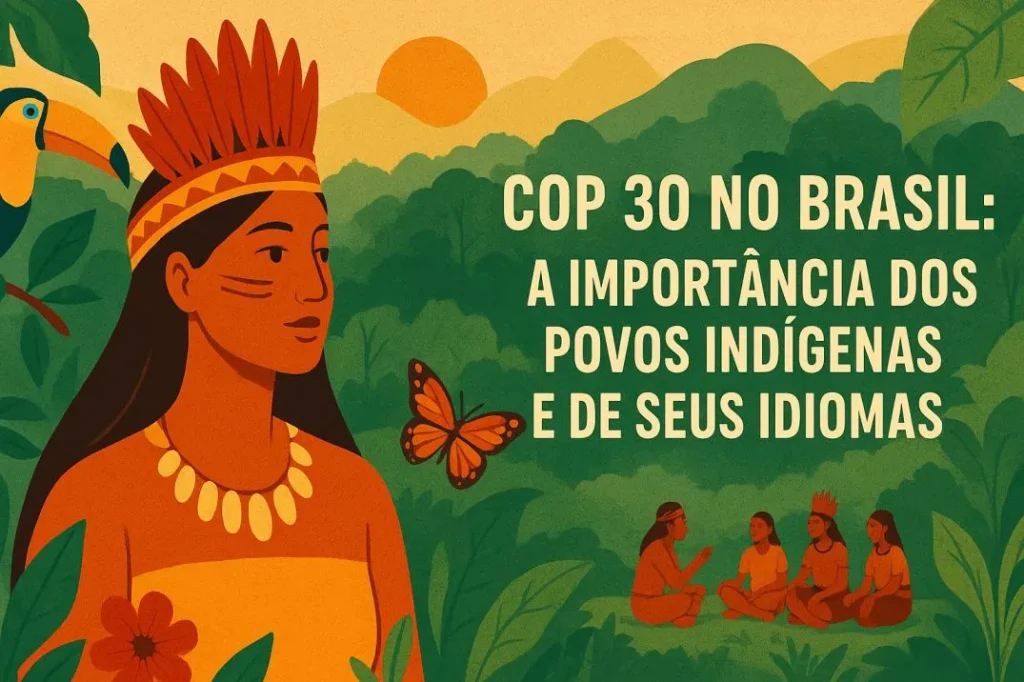
COP 30 IN BRAZIL: THE IMPORTANCE OF INDIGENOUS PEOPLES AND THEIR LANGUAGES
COP 30, which will be held in Brazil, marks a historic moment in global discussions on climate, biodiversity, and cultural preservation. Among its central themes is the crucial role of Indigenous peoples — true guardians of the forests and keepers of millennia-old knowledge transmitted through their ancestral languages.
This article explores the linguistic diversity of Indigenous communities, the origins of these languages, the importance of preserving them, and the leadership of Indigenous peoples at COP 30.
Check out the French and Portuguese versions as well:
👉 French version: https://talkandchalk.fr/cop-30-au-bresil-limportance-des-peuples-autochtones-et-de-leurs-langues/
👉 Portuguese version: https://talkandchalk.com.br/cop-30-no-brasil-a-importancia-dos-povos-indigenas-e-de-seus-idiomas/
THE LINGUISTIC DIVERSITY OF INDIGENOUS PEOPLES IN BRAZIL
Brazil is one of the world’s richest countries in linguistic diversity. Before colonization, an estimated 1,200 Indigenous languages were spoken. Today, around 180 remain, spoken by hundreds of ethnic groups across different regions of the country.
These languages belong to several linguistic families, including:
Tupi-Guarani
Macro-Jê
Aruak (or Arawak)
Karib (or Carib)
Each language conveys a unique worldview, with specialized vocabularies for describing local wildlife, plant life, and spiritual connections to the land. This linguistic richness constitutes intangible heritage of universal value.
Useful links:
FUNAI – National Foundation for Indigenous Peoples: https://www.gov.br/funai
Socio-Environmental Institute (ISA): https://www.socioambiental.org
ORIGINS AND EVOLUTION OF INDIGENOUS LANGUAGES
ORAL TRANSMISSION AND MILLENNIAL KNOWLEDGE
Most Indigenous languages are transmitted orally, reinforcing their dynamic, communal nature. Without traditional written systems, each story, chant, and ritual serves as a living tool for cultural preservation.
TRANSFORMATIONS OVER TIME
Indigenous languages have evolved by incorporating new terms and cultural adaptations. However, after colonization, many of these languages faced:
institutional suppression,
restrictions or prohibitions on their use,
disruptions in intergenerational transmission.
The result has been the extinction of many languages — an irreversible cultural loss.
Useful links:
UNESCO – Endangered Languages: https://www.unesco.org
National Institute of Historic and Artistic Heritage (IPHAN): https://www.gov.br/iphan
THE IMPORTANCE OF PRESERVING INDIGENOUS LANGUAGES
1. CULTURAL IDENTITY AND UNIVERSAL HERITAGE
Each language is its own universe — carrying stories, cosmologies, and unique ways of interpreting nature. Preserving these languages means safeguarding collective memories and millennia-old traditions.
2. ESSENTIAL KNOWLEDGE TO ADDRESS THE CLIMATE CRISIS
Indigenous languages preserve traditional ecological knowledge, including:
sustainable forest management,
identification of medicinal plants,
low-impact agricultural techniques,
long-term climate observation.
This knowledge is recognized by the IPCC as essential in combating climate change.
(IPCC: https://www.ipcc.ch)
3. A RECOGNIZED INTERNATIONAL HUMAN RIGHT
Language preservation is guaranteed by international instruments such as the United Nations Declaration on the Rights of Indigenous Peoples (UNDRIP).
(UNDRIP: https://www.un.org)
THE ROLE OF INDIGENOUS PEOPLES AT COP 30
KEY ACTORS IN CLIMATE PROTECTION
Indigenous peoples safeguard some of the world’s most biodiverse regions — including large portions of the Amazon. Studies show that Indigenous territories are the most well-preserved areas of the forest, due to their sustainable use of natural resources.
ESSENTIAL VOICES IN NEGOTIATIONS
During COP 30, Indigenous leaders will participate in discussions on:
biodiversity conservation,
territorial protection,
climate finance mechanisms,
combating deforestation,
valuing their languages and cultures.
Their participation is vital to ensure that their perspectives are fully integrated into global climate decisions.
Useful link:
UNFCCC – United Nations Framework Convention on Climate Change: https://unfccc.int
CONCLUSION
COP 30 in Brazil offers a unique opportunity for the international community to recognize the cultural, linguistic, and environmental importance of Indigenous peoples. Preserving their languages means preserving the very history of humanity — and, most importantly, ensuring a sustainable future for the planet.
May this global gathering not be limited to debate, but lead to concrete actions to protect territories, strengthen cultures, and value the traditional knowledge that can help us confront the global climate crisis.
