
40 Captivating French Expressions and Their Meanings
French is celebrated worldwide for its elegance and charm—but what truly gives it personality are its colorful idiomatic expressions. These phrases, often rooted in centuries of history and culture, offer more than just linguistic flair: they reveal how French speakers see the world, think, and interact.
In this guide, we’ll explore 40 of the most fascinating French expressions, uncovering their meanings, cultural origins, and the life lessons they carry. Whether you’re learning French or simply curious about its nuances, these idioms will help you see the language—and its speakers—in a whole new light.
1. Quand on veut, on peut – Where there’s a will, there’s a way
A timeless reminder of the power of determination and perseverance. If you truly want something and work for it, the French say, success is within reach.
2. Il ne faut pas mettre tous ses œufs dans le même panier – Don’t put all your eggs in one basket
Rooted in agrarian wisdom, this warns against concentrating all efforts or resources in one place, encouraging diversification and caution.
3. L’habit ne fait pas le moine – Clothes don’t make the man
Appearances can be deceiving; this idiom reminds us to look beyond what’s visible to judge someone’s true character.
4. Qui vivra verra – Time will tell
A calm acceptance of life’s uncertainty—only time reveals outcomes.
5. Mieux vaut tard que jamais – Better late than never
It’s better to act, even belatedly, than not at all.
6. C’est la goutte d’eau qui fait déborder le vase – The straw that broke the camel’s back
The final, seemingly small event that triggers a major reaction.
7. Il n’y a pas de fumée sans feu – No smoke without fire
Rumors often have a kernel of truth—though not always.
8. Chat échaudé craint l’eau froide – Once bitten, twice shy
Past bad experiences breed caution.
9. Appeler un chat un chat – To call a spade a spade
Value straightforwardness over euphemisms.
10. Tourner autour du pot – To beat around the bush
Avoiding the main point in conversation.
11. Mettre la charrue avant les bœufs – To put the cart before the horse
Doing things in the wrong order.
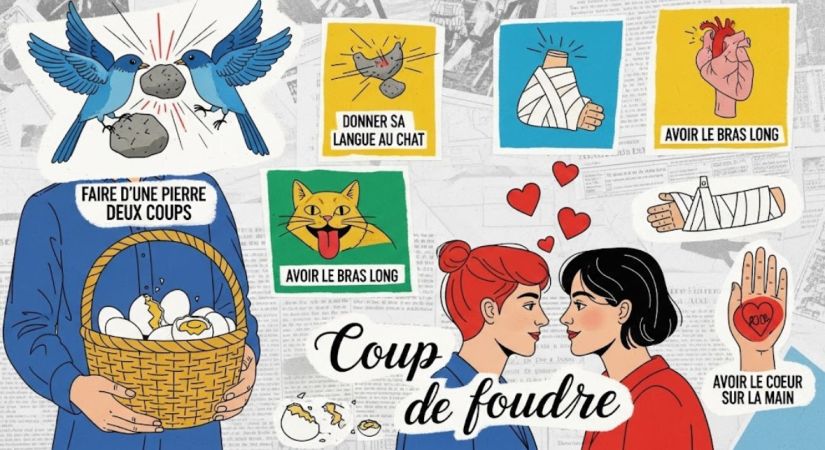
12. Faire d’une pierre deux coups – To kill two birds with one stone
Achieve two goals with one action.
13. C’est en forgeant qu’on devient forgeron – Practice makes perfect
Skill comes from repetition.
14. Les murs ont des oreilles – The walls have ears
Be careful—someone might be listening.
15. Se mettre le doigt dans l’œil – To be completely wrong
A humorous way to admit you’ve made a big mistake.
16. Avoir le bras long – To have a lot of influence
To have powerful connections.
17. Avoir un poil dans la main – To be extremely lazy
A lighthearted jab at someone who avoids work.
18. Ne pas être dans son assiette – To feel under the weather
Feeling unwell or off-balance.
19. Tirer le diable par la queue – To live hand to mouth
Struggling to make ends meet.
20. Avoir la tête dans les nuages – To have one’s head in the clouds
Being dreamy and distracted from reality.
21. Jeter l’argent par les fenêtres – To throw money out the window
Spending recklessly.
22. Tomber de Charybde en Scylla – Out of the frying pan, into the fire
Going from a bad situation to a worse one.
23. Couper la poire en deux – To split the difference
Meeting halfway in a negotiation.
24. Rire jaune – To give a forced laugh
Laughing despite discomfort or annoyance.
25. Être au septième ciel – To be on cloud nine
Overjoyed or blissfully happy.
26. Avoir un coup de foudre – Love at first sight
An instant, intense romantic attraction.
27. Mettre son grain de sel – To add one’s two cents
Offering unsolicited advice or opinions.
28. Jeter de l’huile sur le feu – To add fuel to the fire
Making a tense situation worse.
29. Avoir les yeux plus gros que le ventre – To bite off more than one can chew
Overestimating your abilities or appetite.
30. Se serrer la ceinture – To tighten one’s belt
Cutting back on spending during tough times.
31. Battre le fer tant qu’il est chaud – To strike while the iron is hot
Seizing the moment.
32. En faire tout un fromage – To make a big deal out of nothing
Exaggerating the importance of a small matter.
33. Avoir d’autres chats à fouetter – To have other fish to fry
Having more important things to deal with.
34. Être dans de beaux draps – To be in a fine mess
Finding yourself in trouble.
35. Faire la grasse matinée – To sleep in
Enjoying a lazy morning in bed.
36. Mettre de l’eau dans son vin – To tone things down
Softening one’s stance or approach.
37. Crier sur les toits – To shout from the rooftops
Publicizing something widely.
38. Avoir le cœur sur la main – To be generous
Being open-hearted and giving.
39. Avoir une faim de loup – To be starving
Extremely hungry.
40. Passer une nuit blanche – To pull an all-nighter
Spending the whole night awake.
Conclusion
French idioms are far more than linguistic curiosities—they are cultural snapshots, each revealing a slice of history, humor, or human truth. By learning them, you don’t just enrich your vocabulary—you step into the mindset of a culture that values wit, nuance, and vivid imagery.
Whether you use them in conversation or simply enjoy their poetry, these expressions are your key to speaking French with authenticity and flair. So, the next time you want to sound truly francophone, try slipping one into your speech—you might just find yourself au septième ciel.
