
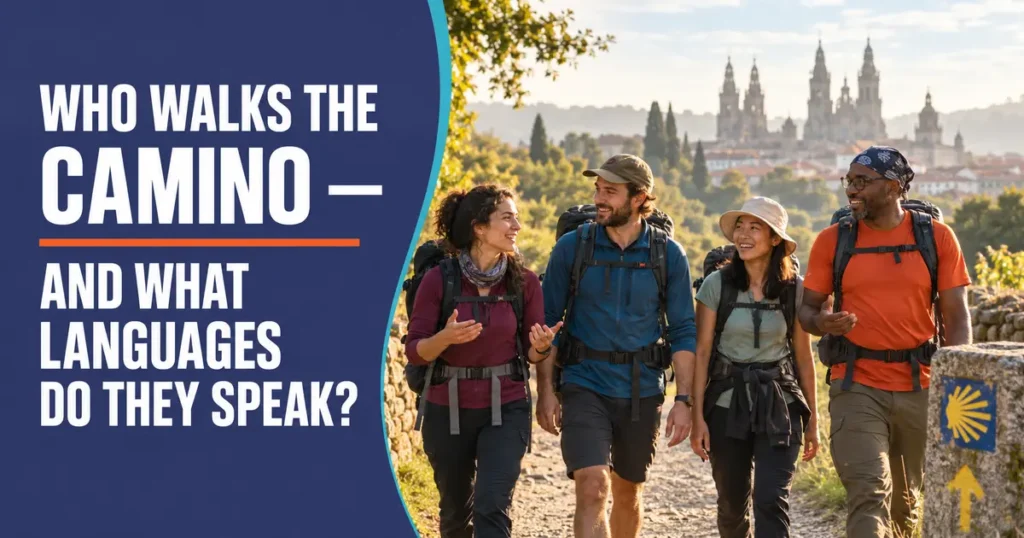
Quick answer: The Camino de Santiago welcomes people of many ages and nationalities. Spanish is the most practical language on most routes, Galician shapes the culture of the final stages, Portuguese is prominent on routes from Portugal, and English often becomes the shared language among international pilgrims.
Languages on the Camino de Santiago are part of the journey itself. Every day, hikers share rooms, meals, directions, sore feet, and personal stories with people they may never have met anywhere else. The route is not only a trail to a cathedral; it is also a moving classroom in culture and communication.
In 2025, the Pilgrim’s Office recorded more than 530,000 Compostelas, the certificates issued to pilgrims who meet the official requirements. That figure does not include everyone who walked, but it reveals the extraordinary scale of the modern Camino. Travelers arrive from Spain, Italy, Germany, France, Portugal, the United Kingdom, the United States, Brazil, South Korea, Japan, and many other countries.
So who walks the Camino, which languages will you hear, and how much Spanish do you really need? This guide answers those questions while helping U.S. travelers prepare for a more confident and meaningful experience.
What exactly is the Camino de Santiago?
The Camino de Santiago is not one road. It is a historic network of pilgrimage routes that leads to the Cathedral of Santiago de Compostela in Galicia, northwestern Spain. Christian tradition associates the cathedral with the remains of Saint James the Apostle.
Religion remains important, but modern pilgrims walk for many reasons: reflection, grief, celebration, fitness, cultural curiosity, a career transition, or the desire to slow down. Some complete only the final section; others travel for weeks or months across several countries.
The best-known Camino routes
- Camino Francés: the classic and busiest route, crossing northern Spain from the Pyrenees.
- Camino Portugués: a family of routes beginning in Portugal, commonly from Lisbon or Porto.
- Portuguese Coastal Way: a scenic route along parts of the Portuguese and Galician coasts.
- Camino del Norte: a demanding route along Spain’s northern coast.
- Camino Primitivo: one of the oldest and most mountainous options.
- Camino Inglés: historically connected to pilgrims who reached Galicia by sea.
The official Pilgrim’s Office statistics provide annual information on routes, starting points, nationalities, ages, and reasons for walking.
Who walks the Camino de Santiago?
There is no single “typical pilgrim.” College students walk beside retirees. Solo travelers meet families, religious groups, long-distance athletes, and professionals taking a break between chapters of life. Recent records also show that women slightly outnumber men among Compostela recipients.
Age is equally diverse. Many pilgrims are middle-aged or over 60, which challenges the idea that the Camino belongs only to young endurance athletes. Preparation matters, but the route offers many distances, terrain levels, and daily rhythms.
Starting points influence the experience. Sarria is especially popular because it sits just beyond the minimum walking distance required for a Compostela. Porto and Tui are major gateways on the Portuguese routes, while Saint-Jean-Pied-de-Port attracts people seeking a longer Camino Francés experience.
A useful distinction: official figures count Compostelas issued, not every person on the trail. Some hikers walk shorter sections, skip the certificate, or travel for purely recreational reasons. The true number of people experiencing the Camino is therefore higher.
Languages on the Camino de Santiago: what will you hear?
Spanish: the language of everyday logistics
Spanish is the most useful language on the majority of routes in Spain. It helps you check into an albergue, ask about a meal, explain an injury, understand trail information, arrange transportation, and speak with residents in smaller communities.
Tourist areas may offer English-language service, but rural villages are different. Even basic Spanish can provide independence and reduce stress. More importantly, it changes the quality of your contact with the people who live along the route.
Travelers who want focused preparation can explore our Spanish courses in Carrollton and online. Lessons can concentrate on the situations and listening skills you will actually need while traveling.
Galician: the language of the destination
As the Camino enters Galicia, travelers encounter Galician on road signs, storefronts, menus, place names, and in everyday conversation. Galician and Spanish are both official in the region.
Galician shares deep historical connections with Portuguese. A speaker of Spanish will recognize much of it, while Portuguese speakers may notice familiar vocabulary and sounds. Still, Galician has its own identity, standards, literature, and cultural history. Hearing it is part of understanding where the Camino ends.
English: the international bridge
Among international pilgrims, English often serves as a lingua franca. It may not be anyone’s first language at the dinner table, yet it helps a Korean walker, a German cyclist, an Italian student, and an American traveler exchange stories.
This creates an encouraging communication environment. People simplify sentences, repeat patiently, gesture, and help one another. Fluency is less important than clarity, curiosity, and the willingness to listen.
Portuguese: essential on routes from Portugal
On the Camino Portugués, Portuguese is naturally part of daily life before the route crosses into Spain. Pilgrims use it in cafés, accommodations, transportation hubs, and conversations with local residents.
After the border, Spanish and Galician become more visible. The transition offers a fascinating lesson in neighboring languages: Portuguese and Galician can feel familiar to each other, yet each has a distinct modern identity.
French, German, Italian, Korean, and more
Because the Camino attracts a global public, you will also hear French, German, Italian, Dutch, Polish, Korean, Japanese, and Scandinavian languages. A single albergue kitchen can contain several languages at once.
Sometimes the conversation moves between Spanish and English. At other times, people use translation apps, sketches, gestures, or a few newly learned words. These imperfect exchanges are often among the most memorable moments of the trip.
Useful Spanish phrases for the Camino
| Spanish | English | Situation |
|---|---|---|
| ¡Buen Camino! | Have a good Camino! | Greeting other pilgrims |
| ¿Cuánto falta para llegar? | How much farther is it? | Checking the distance |
| ¿Hay camas disponibles? | Are there beds available? | At an albergue |
| Necesito ayuda. | I need help. | In a difficult situation |
| ¿Dónde puedo llenar mi botella? | Where can I fill my bottle? | Looking for water |
| ¿Puede sellar mi credencial? | Can you stamp my credential? | Recording a stage |
How languages transform the Camino experience
Language preparation does more than solve practical problems. It creates access to stories. A simple question can reveal why someone started walking, what they left behind, or what they hope to find in Santiago.
Communication also improves safety. You can describe pain, ask for a pharmacy, confirm a route change, understand an albergue rule, or explain dietary needs more precisely. You do not need advanced fluency. A focused set of phrases and listening strategies can make a significant difference.
A practical language plan before your trip
- Study real situations: lodging, food, directions, health, weather, and transportation.
- Train your ear: listen to Spanish spoken at different speeds and with different accents.
- Learn complete phrases: they are easier to retrieve under pressure than isolated vocabulary.
- Practice clarification: phrases such as “Could you repeat that more slowly?” keep a conversation moving.
- Accept imperfection: your goal is respectful, effective communication—not a flawless performance.
If you are unsure where to begin, our language level tests can help you identify your current level before building a personalized study plan.
Quick Camino language challenge
Choose the best answer for each situation.
1. How do you ask whether beds are available?
2. Which co-official language will you encounter in Galicia?
3. What does “¡Buen Camino!” express?
Frequently asked questions
Do I need to speak Spanish to walk the Camino?
No, but basic Spanish makes the trip safer, easier, and more rewarding. English is common among international travelers, yet it is not guaranteed in every village or small business.
How many miles do I have to walk for the Compostela?
The traditional minimum on foot is 100 kilometers, or about 62 miles, along an officially recognized route. Requirements can change, so confirm the current rules with the Pilgrim’s Office before traveling.
Will people understand English?
Often, especially in major towns and among other pilgrims. However, relying only on English limits some local interactions and can create difficulties in rural sections.
Which language should I study first?
Spanish offers the greatest practical value on most routes. English helps with international encounters, while Portuguese becomes especially useful if your route starts in Portugal.
Can I take travel-specific lessons?
Yes. A personalized course can focus on the exact route, situations, vocabulary, and listening challenges you expect instead of following a general textbook sequence.
The Camino is also a journey through language
The Camino de Santiago brings together people whose paths might never cross elsewhere. Every language carries a different way of seeing the world, while the shared act of walking creates common ground.
Talk and Chalk offers personalized online and in-person training in more than 40 languages. We can build a practical program around your route, current level, schedule, and real travel needs. Contact Talk and Chalk to prepare for your Camino with confidence.
